
WHAT ARE PFAS?
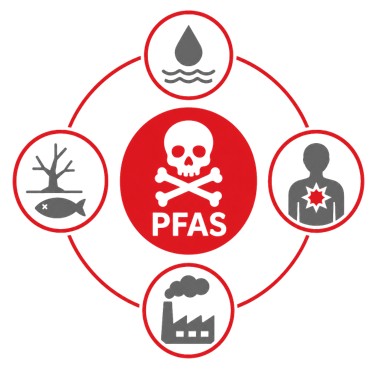
PFAS (per- and polyfluoroalkyl substances) are a large class of synthetic chemicals that are extremely persistent and are therefore also known as “forever chemicals”. Many people encounter PFAS indirectly in everyday life, for example in coated non-stick pans, which are often known by the brand name Teflon. Due to their special properties, PFAS are used, among other things, to make products water-, grease-, dirt- or heat-resistant.
The problem: PFAS are very difficult to break down in the environment. They can remain in soil and water for years or decades, travel over long distances and accumulate in plants and animals.
People and animals can absorb these substances through water, food and the environment. PFAS can accumulate in the body and may affect the immune system, liver, metabolism, reproduction and development, among other things.
Their exceptional persistence and widespread distribution make PFAS a burden on the environment, animals and people. This is why the following question is becoming increasingly important: How can we avoid PFAS in our everyday lives and reduce their release into the environment?
WHY ARE PFAS USED IN ADHESIVES?
PFAS are used in certain anaerobic adhesives to optimise the coefficient of friction between screws and threads.
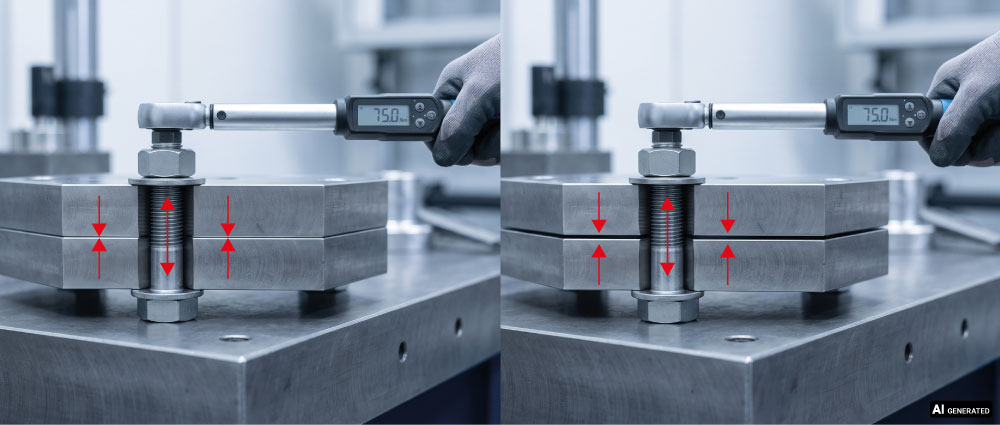
But what does the coefficient of friction actually mean? Put simply, it describes how strongly two surfaces resist sliding against each other. A low, precisely controlled coefficient of friction ensures that less tightening torque is lost to friction when a screw is tightened.
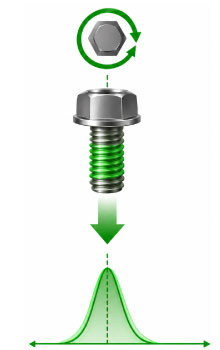
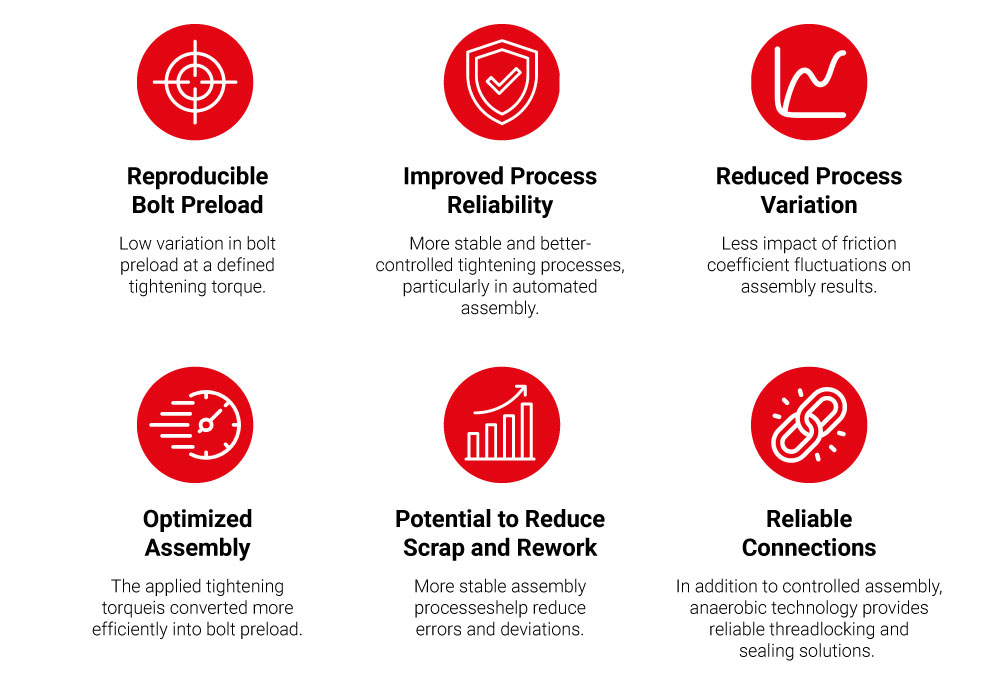
This has a direct impact on the preload:
This allows the screw connection to be assembled in a controlled and reproducible manner.
THE PROBLEM
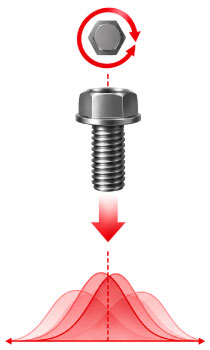
The same tightening torque does not necessarily result in the same preload. Thread-locking products that are not optimised for the coefficient of friction can lead to fluctuating friction values and, consequently, varying preload forces. This has a direct impact on your assembly process and product quality.


Switzerland
Brütsch/Rüegger Werkzeuge AG
Heinrich Stutz-Strasse 20
Postfach, 8902 Urdorf, Schweiz
P +41 44 736 63 63
F +41 44 736 63 00
www.brw.ch
Germany
Brütsch/Rüegger Tools GmbH
Edisonstraße 7-11
68309 Mannheim
P +49 621 72006-0
F +49 0621 72006-79
www.brw-tools.de/de
Würth Industrie Service GmbH & Co. KG
Industriepark Würth
97980 Bad Mergentheim
P +49 7931 91-0
F +49 7931 91-4000
info(at)wuerth-industrie.com
www.wuerth-industrie.com
Hahn & Kolb Werkzeuge GmbH
Schlieffenstrasse 40
71636 Ludwigsburg
P +49 7141 498 40
bestellung(at)hahn-kolb.de
www.hahn-kolb.de
Hommel Hercules
Heidelbergerstr. 52
68519 Viernhein
P +49 6204 / 739-0
info(at)hommel-hercules.com
www.hhw.de
Austria
Kellner & Kunz AG
Boschstrasse 37
4601 Wels
P +43 7242 484 0
www.reca.co.at
Belgium & the Netherlands
VIBA BVBA België
Industriezone Puurs nr. 496,
Rijksweg 49 bus 2
2870 Puurs
P +32 (0)3 866 11 32
www.viba.nl/nl/pageid/ergo
Denmark
Dana Lim A/S
Københavnsvej 220
4600 Køge
P +45 56 64 00 70
www.danalim.dk
Italy
Würth S.r.l.
Bahnhofstraße 61
39044 Neumarkt (BZ)
P +39 0471 828681
industria(at)wuerth.it
www.wuerth.it
Remak S.r.l.
Sede operativa Via Grosio 10/10
20151 Milano
P +39 02 30302525
F +39 02 30 3025222
www.remak.it
Poland
ASTAT sp. z o.o.
ul.Dabrowskiego 441
60-451 Poznan
P +48 61 848 88 71
astat.com.pl
Slovenia
JUB kemicna lndustrija d.o.o.
Dol pri Ljubljani 28
1262 Dol pri Ljubljani
P +386 1 588 43 27
www.jub.eu
Czech Republic
5M s.r.o.
Na Záhonech 1177
686 04 Kunovice
P +420 572 433 711
www.5m.cz
